Saturday, 8 August 2015

Being Above Board

It's an interesting time in brewing. With Craft Beer seemingly going from strength to strength the appearance to the outside world is that it has to be a great thing to get into. In many ways it is, and living he dream can be very rewarding, but not without it's troubles.

It is true that the price of a pint in those contemporary craft beer bars is going up. The disparity between that and some more traditional pubs is disconcerting to some. Equally the fact that often keg beer is more expensive than cask also causes some angst.

This article is inspired by the news that Jarrow Brewery has recently had over 20,000 litres of beer seized by HMRC. It seems unclear exactly why. HMRC seem to state that they were brewing, and hinting that they were selling beer without a licence. The brewery simply state that beer has gone out of date because they can't sell it without a licence. Either way, it seems a drastic step to seize beer if there isn't a concern that underhand stuff is going on.

It continues to be a problem for brewers to get their beer to market. With an ever increasing number of breweries inevitably there is significant competition. At times that competition can manifest itself as eye-watering price cutting at wholesale. Off course, in a competitive capitalist economic system this is what we expect.

The unfortunate side effect of this is that there are going to be casualties. Equally, in desperate attempts to stay afloat, some might be tempted to moving a little to he wrong side of the law. I do hear reports from publicans about sales of beer "without paperwork" I am told that the way this is handled for the beer duty return is that the beer is officially not sold, but instead has been "destroyed".

To compound this situation HMRC have been somewhat silent for several years. When we first started brewing we got two visits from HMRC. Both went reasonably well and we were signed off as compliant. It was slightly nerve wracking, but I found the inspectors all very helpful. In discussing the destruction of beer I had some helpful tips from one very nice officer which basically run a long the lines that if it was the occasional cask then we should just get along and do it. If it was a whole gyle, a good number of casks, or a regular thing, we ought to let him know, just so as he could come along if he wished and witness the destruction.

We did that, on an odd occasion, when we were unhappy with a beer, and tipped a whole tank down the drain. Back then, around 2010, we were still only around 350 litres, 3.5hl, 8 firkins or 2 brewery barrels per brew. He was grateful I got in touch and said it was OK to just get on with the job of tipping it down the drain. Provided of course that United Utilities was happy that we had the correct discharge authorisation.

Since then this particular gent has moved on. Indeed, the last communication was that officers were being thinned out as a result of cutbacks caused by the economic situation. We even had one officer telling us that really, us little guys were not much of a concern as there were much bigger fish to fry. We were told we should just record all the beer we destroy and not worry about it.

So, you can see that this is a clear signal to go ahead and pretend that beer is being destroyed, when in fact it is being sold "without paperwork" for cash, no questions asked. Beer duty and VAT no doubt being evaded. I know quite a few business friends that think this is not only OK, but the only thing that can keep a business alive in a tough competitive time. After all, it'd be doing the beer drinker a service by getting the cost of their pint down.

But I do worry about it. In fact, the fear of HMRC coming and finding something is amiss and we'd get a great big tax bill we can't pay is something that fears me most in this business. We do not sell beer "for cash, without paperwork" Obviously we take cash, it is handy to avoid bank charges, and is perfectly legal, but we record it and issue an invoice. For a start, I want a new brewhouse. Hiding turnover and profit from the tax man also hides it from the bank manager. The banks want to see legal economic performance if they are going to lend for new shiny stainless steel.

Evading the tax man is something that I particularly find offensive. Yes, I think we pay too much tax, but we are all a liberty to vote for the politicians that decide what is going to be taxed, and how much tax is to be charged. We are also all at liberty to lobby who ever we like, demonstrate legally or complain about taxation on our blogs. However, once the taxation system is set, we all have a duty to put into the coffers what is due.

Now, as there are more and more breweries, there is more and more cut throat competition and more and more breweries desperate to make their dream work. Many of us in the industry are worried that this is going too far, and that the price of cask beer at wholesale is becoming increasingly unsustainably cheap.

What I do know is that as the economic situation continues to improve HMRC are again being funded a little better. With the increasing number of breweries, and evidence becoming clear that micro-breweries are in fact now contributing to the avoidance of duty, make no doubt about it HMRC will again be knocking on our doors.

HMRC are also looking at the whole supply chain. Since last year it has been a legal requirement to ensure that we are confident that anyone we sell beer to is adhering with the law. In the New Year HMRC will require every wholesaler to register. In some ways all of this puts an ever increasing burden on those of us who are already trying very hard to ensure we are above board.

Luckily, SIBA are doing quite a lot to support us. They have various tools available on the website in the members area.

Despite this I expect over the next couple of years some breweries will only able to keep trading by avoiding some beer duty and VAT. These breweries are going to find it difficult. I wonder if Jarrow is the start of the whole pack of cards tumbling? Certainly, those breweries who already have a strong pricing structure, defended by good marketing, strong PR message, quality beer and adherence to the law are much more likely to survive.

Tuesday, 4 August 2015

Nucleated Mind

Yesterday we launched our beer, Nuclear Sunset. It occurs to me that my blog post was a little ill-thought out, and perhaps some other things I've written. I've been working on this for a couple of weeks, on and off, so yesterday I was somewhat blasé about the subject. Besides, we were bottling and sending out some samples, so I was also quite busy.

Not surprisingly there has been a view from some that using the subject of the bombings of Hiroshima and Nagasaki as a way to sell beer is "grotesque". Yes, I'd like to sell more beer, of course I would, but I genuinely care about the issues I'm trying to raise. This piece will become a personal expression of my feelings. From my heart. It might well end up being too honest. I'd like to write now about my own personal feelings surrounding this. Explain where I am, where I come from and detail my own thoughts about the subject.

I am fairly completely the result of an atomic age. My parents met when they both worked at Windscale1. When they got married my father decided to return for a short while to teaching. They settled in Kendal and I was born. However, perhaps due to the draw of the good salary and conditions at Windscale, or perhaps he just didn't like teaching, whatever, we moved to Seascale, where I spent the next 14 or so years growing up. Some days I wonder how my life would be had they stayed in Kendal.

Seascale is less than two miles from the perimeter fence of Sellafield. Most of the people who live there work at Sellafield. Indeed, many have been born there and their parents, and perhaps even grandparents worked at the plant. I still know many people who live there and I care about these people a lot.

During the 70s and 80s there was significant media attention, not unreasonably, as a result of various problems at the plant. Back in 1957 there was a fire. That was fairly heavy shit, to be fair. It should never have happened and was mainly due to the drive to produce our own UK nuclear deterrent. During the 60s and 70s and beyond the public became more and more concerned about the safety of nuclear power. In the 70s a program called Not The Nine O'Clock News did a spoof of the Ready Brek advert. For a kid living close to the plant, we didn't really find it that funny. In the 80s there was also the regrettable incident of the beach contamination and various other events. The press surrounding the events sometimes made us feel like we were in a microcosm very different to the rest of the world. When on holiday it was genuinely scary to mention where we lived.

In 1981 I was lucky enough to start an apprenticeship at the plant. The company subsequently funded my Open University degree. I ended up doing a fairly interesting job for a while, and the salary was very good indeed. Leave, pension, heath care and working hours all very favourable. Why on earth did I leave? It was a job for life, very probably, had I just stuck in and played the game.

But I'm not like that. I get frustrated easily. I like to get things done, and progress a job. I'm quite individual and in reality felt a lot like a square peg in a round hole. Having to do a written justification for nearly every move eventually drove me to near breakdown2. In 2003, after being there over 22 years, I left and bought a pub. There are days when I wonder why, but I did, and I am now doing what I do, dreaming that one day I'll make a sufficient success out of it to be able to retire.

During my time there I learnt about various things to do with potential accidents called "criticality"3 - I worked closely on systems that were designed to prevent such events. In brief, a criticality incident is where an uncontrolled fission chain reaction occurs giving out intense bursts of radiation. It is quite different to a nuclear explosion,  keeping fissionable material together long enough to explode is in fact, incredibly difficult to achieve.

Prevention of criticality events is probably one of the most rigorous and carefully thought through combinations of science and engineering I can imagine. Indeed, the complexity of the whole technology was the part of the job that thoroughly fascinated me4. But what captured my imagination more than anything was the very need for such layers of safety.

The intense radiation that is given off without warning when an accident like this happens will give personnel a lethal dose of a combination of gamma and neutron radiation in microseconds. The last time I know that this happened was in Japan at the Tokaimura plant. Two people died. Death from radiation is very, very slow and protracted. Closer to home we are all familiar with the death of Alexander Litvinenko from polonium poisoning. A different cause, but the effect is similar.

I have had an interest, not a macabre fascination, but a sympathetic empathy for anyone who has been exposed to such lethal doses of radiation. In our training, we were given advice as to what to do in the event of the very specific alarm should such a criticality event occur. On the flip chart, the lecturer would write, "RUN LIKE F....."5 and leave the last bit unwritten. The very obvious intent of the word might have offended, in a formal and large company environment was unusual, but the effect of implying the very real dangers of such an incident justified the potential offence. Just to pacify sensitive course attendees, he would then complete the sentence "RUN LIKE FURY" but we'd already got the point.

The difference between these criticality accidents and an atomic bomb is the fact that it is only when assembled in a bomb, and detonated with an implosion shock-wave6, do we get anything that might approach a nuclear explosion. I know very little about this part of nuclear technology. I'm really quite thankful that I don't know more. This part of nuclear warhead production does not and never has occurred in West Cumbria. If you want to know more, go and find out for yourself.

So, nuclear warheads. Frankly, they terrify me. Nuclear technology doesn't, beyond the criticality scenario I explain above. But the effect of nuclear detonation, deliberately to cause the biggest bang that is humanly achievable, really does scare the living shit out of me.

The suffering of the casualties in Hiroshima and Nagasaki genuinely moves me. Having undergone training over many years to drive home to me the dangers of the materials present on nuclear sites, it is difficult to not feel affected thinking about the utter devastation. The question of whether in fact the Americans had to drop those bombs to end the war is still unanswered in many war historians minds. We simply cannot know the answers to the questions. Even so, if they had not dropped the bombs then, might some other world conflict have precipitated something similar? Pandoras box is open, and we cannot get that genie back in that bottle.

We now know what the effects are. Subsequent American occupying troops documented details of the effects of the radiation on the sufferers. The troops did nothing to help the victims, just monitor, document, for the record, the technical biological effects. We know what happens now, we do not need to repeat that experiment. Indeed, it is difficult not to think that the real need of the Americans was to prove the bomb. After all, they had spent a colossal amount of money on the project, they might never, ever have the justification to drop a bomb again. We can't deny it proved the point.

The problem with the whole question of nuclear is the conflation of the aggressive use of military nuclear technology with peaceful power generation. It is true that the technologies do have some unfortunate cross-overs. It is possible for a state that has a peaceful nuclear program to divert into military use. However, we can say the same for conventional explosives, and for that matter chemical and biological technology.

Additionally, set between Sellefield, and BAE in Barrow where nuclear submarines are made, I cannot ignore the very great economic impact on my part of the world should we eradicate nuclear. The whole of the economy in my area depends very heavily on these industries. Should we abolish completely nuclear technology we'd have to think very carefully about how we manage thousands of people that have no other skill-sets outside the industry. They can't all go off and brew beer.

Something that is very close to my heart is the consideration of energy generation. It seems to be generally considered that global warming is real. There are not very many people who deny7 that at least in part global warming is increased by man's industry. I've recently been to Chamonix in the French Alps. There are a number of glaciers there that have retreated significantly over the time I've been visiting. One railway that connects the town to the most famous glacier, Mer de Glace, is now in completely the wrong place resulting in a significant climb down to get to the surface.

Renewables are a solution. Personally I love wind turbines, which isn't an entirely universal thought in our part of the world. Solar in the UK I think might be dubious, but I'm hoping that the technology will improve.

Covering the Sahara Dessert in solar panels might be helpful. I know enough about electrical transmission to at least question how efficient the movement of this energy would be. Hydro might help, but how many valleys might we need to dam, and how popular will that be? Biomass, anaerobic digestion and wind do have a part to play, and absolutely we should explore all of these, but I doubt they'll solve the problem in time.

Since I was born in 1965 world population has more than doubled. In the same time global energy usage has more than tripled. Most of the increase in energy usage has come from fossil fuels. Whatever your belief is about global warming, oil will become more difficult to find and more expensive to extract. We may have to accept fracking, for instance, if we cannot find ways of reducing fossil fuel dependancy.

Although it might not be something that gets general public agreement, especially after major disasters like Fukushima and Chernobyl, but I believe we have to keep nuclear energy as a tool in our kit of things to help us into the future. Yes, we have to learn how to do it right, and my ex-colleagues are working very hard to help do that.

But back to my original intent to attach the question of nuclear to the beer we have just released. I have read extensively about nuclear weapons and their direct and indirect impact on populations. I personally feel that the questions in the minds of the general public have subsided over the years since the peak of questions back in the 60s and 70s. I do not think it is wrong to reignite that whole question.

Perhaps my intent is "naff" I don't know. Perhaps it is just the actual application of my intent that isn't quite right. Maybe as a businessman I should have just got on with the job of selling my beer and leave these issues for someone else to address.

That perhaps is true. Perhaps I should have just left this particular dog to sleep. I expect that at some point in time this issue would have surfaced and what I'd hope is that what I've written here makes it clear that the issues are genuinely important to me.

Sellafield, formally Windscale is there as a direct result of The Manhattan Project. I was conceived because my parents met at Windscale. I am truly a product of the nuclear age. I cannot undo that.

So, when I think about the dropping of the bombs on Hiroshima and Nagasaki, about the suffering of the people. About the people who didn't even know what happened because they were vaporised instantly. Or about the people who suffered for many days, weeks or even months afterwards only to die a painful and distressing death as a result of what was argued a necessary action to end the war with Japan. When I think about the people that survived, and rebuilt the cities, rebuilt their lives and still remained scarred both physically and mentally, I remember that my life and theirs are inextricably linked.

And so is my beer. I am my beer and my beer is me. I don't make a huge amount of money out of beer. Hardknott is still a frighteningly small and vulnerable business. Yes, we'd like to sell more beer. I'd like everyone to like what I do.

I am who I am and I do what I do because I care about what I do. I want to make good beer, and I would like to get it out to more people. I also care about the future of mankind, how we make the world a better place for us all to live in. Is it my place to raise awareness of a terrible event that occurred 70 years ago? Perhaps not, but I've done it now. I expect I'll have got people to talk little more than they would have otherwise done. I expect in reality it'll not make much difference to my business.


----------

1Windscale was the name then given to the place we all know as Sellafield. Back in the late 70s the people in charge changed the name as Windscale had got itself a bad name. There were all sorts of excuses given back then, but we all know it was a PR thing.

2I would not even want to try and suggest that anything should change in the way that safety is conducted on the site. I do not think it is wrong to have the inevitable heavy layers of safety systems that exist. Some people revel in that environment and many of my friends work there and continue to keep our nuclear industry safe. It's just not for me.

3Life after Sellafield is an interesting thing. There are things I know, mostly things that are available for people to look-up in Wikipedia, that I am unsure how sensible it is for me to discuss. I am of the view that mentioning criticality incidents is reasonably safe a thing to discuss. It is all very well documented on the internet and something that concerns a fair few people who work at the plant.

4It might be worth pointing out that nuclear safety is something that is totally necessary. I might have already given the wrong impression by suggesting that it is this that drove me away. Not at all. I was genuinely very much enthralled with the necessity to ensure safety of nuclear material. Having multiple layers of safety mechanisms so that the risk is kept as small as humanly achievable is paramount. It was the stuff like "hold on to that handrail when walking up stairs" was what drove me mad. FFS, I'm a climber in my spare time, I'm not having some jumped-up manager tell me I can't walk up and down stairs without holding the handrail, that's just daft.

5Conventional evacuation of a building, in the event of fire for instance, advises that people should simply walk in a calm manner. Panic in such cases might cause bigger issues than the danger actually presented. We were left in no doubt that panic was indeed the thing you should do in the event of a criticality. The technical reasons for this are that fissionable material, when in solution, may well boil the solution in the event of a criticality and the resultant foam be sufficiently sub-critical to halt the event. However, once the foam died down, it might go critical again, and so cause pulses of radiation. The first pulse might not be enough to kill you, so run like fuck whilst you have the chance and are still able. The inverse square law may yet save you.

6Holding together a fissioning chain reaction is incredibly difficult. The energy involved in these events is so incredible that even the thickest vessel would be torn apart in microseconds creating a nuclear "fizzle"

7I actually have a cousin who is highly active as a sceptic of global warming science. I'm not sure I understand what he gets up to, but I admire his approach. What is important is to question, and to keep questioning our rational. There is danger of group think. I like the fact that we can discuss issues in our society. The fact we can question various outputs of human learning, opinion and scientific research is part of what makes us human. It is important in a democratic society that we can do this. I do not expect the reader to agree with my points in this piece, or for that matter anything else I write. But it is important to be able to rationally, intelligently and constructively debate.

Monday, 3 August 2015

Explosions

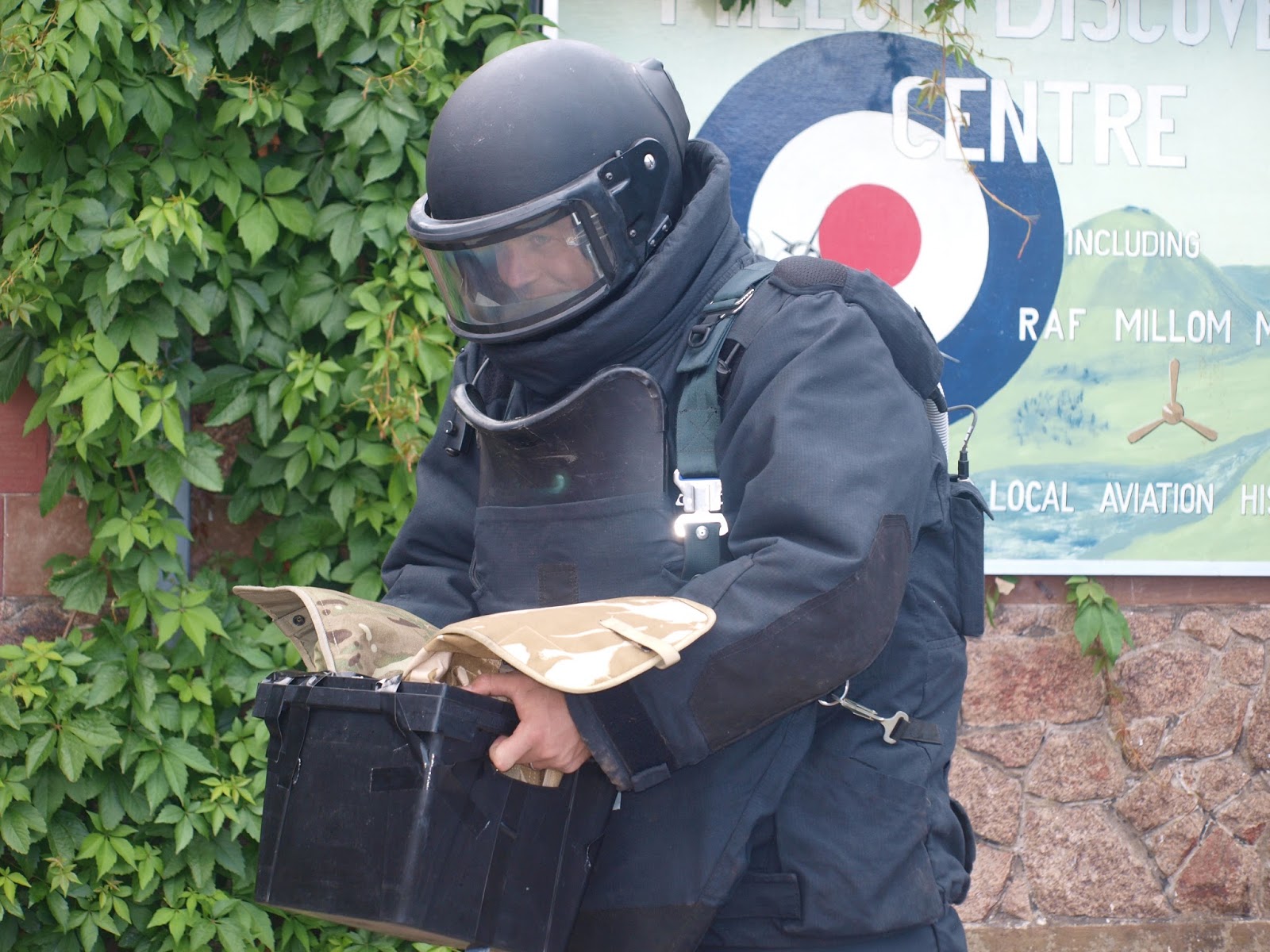
The bomb squad turned up at our bar on Saturday. We share the building with a museum. It seems a long time ago people had donated mining memorabilia to the museum and amongst the stuff was a stick of dynamite. Just to make things worse, as the dynamite was at least 50 years old, it had turned crystalline, and so risked spontaneous detonation with the slightest knock. The museum staff quite rightly contacted the authorities. A couple of nice blokes in fatigues, and a van full of very expensive toys turned up.

The dynamite was moved to the school field and a controlled explosion was carried out. Unluckily for the school kids the school was undamaged, even so I have the song "We break up, we break up, we don't care if the school blows up" running through my head.

More seriously, and by complete coincidence, we are releasing a beer today. It is called Nuclear Sunset and is 4.7% ABV. It is a wheat beer that was inspired by a Japanese beer. It is made not only with orange peel and coriander, but also has orange juice and nutmeg in it. Unlike european wheat beers this one is fermented with our house yeast1, which is an American ale yeast.

The rather troubling thing for me is that I now worry people will believe I planted that stick of dynamite to further the launch of this beer. If only I were that clever, and devious. But no, trust me, I had this all thought through well before the weekend.

There is a bit of a story to this beer. Scott came up with the name Nuclear Sunset, which I instantly liked. However, whilst putting together the backstory to the beer I realised that this week is the 70th anniversary of Hiroshima and Nagasaki. 6th and 9th August to be precise. This could not be ignored.

I've already written quite a lot about the topic, for our press release, as covering emails to go out with the press release, our website and for a comment piece to go on Roger Protz's1 website, so I'm not going to put too much down here. But what I will say is that the power of the atomic explosions is something that genuinely moves me. The suffering that the people in Hiroshima and Nagasaki must have gone through is incredible. It is humbling to me to know that science can bring both great technological achievements, but not without great dichotomies for humanity to consider.

Couple this with the fact that I am where I am today partly due to a previous career in the nuclear industry. But even more importantly, I live in a community that depends upon nuclear technology for its very existence, the importance of this fact can not be under estimated.

I hope you will all understand my genuine need to honour the people of Japan on this anniversary. This need for me is all the more acute as I am in favour of peaceful uses of nuclear technology, but at no time do I ever underestimate it's dangers if mankind misuses the technology in the future. I truly hope we continue to take seriously our responsibilities and hold precious the thought that the errors should never be repeated.

----------

1As I type this the piece it is yet to go up on his site. He's in the middle of finalising the Good Beer Guide and we're just getting the final copy agreed before it goes up.

Tuesday, 28 July 2015

Email marketing

Obviously, I'm always on the lookout for ways to persuade people to buy our beer. There are a lot of breweries selling beer now, so being proactive is just about essential.

Ann was sending out an email list of beer availability to pubs and wholesalers every week. It's informative, but normally not particularly eye catching. She sends it out manually, populating the BCC field herself (copy and paste, I expect)

Yesterday I decided to have a look at MailChimp. It produces nice output and emails to people as HTML formatted pages. I think it is handy, and has various features that are useful. If you've not tried it, and you send out emails manually like Ann was doing, then perhaps you should give it a look.

I think it would be handy to have a list of people, Hardknott fans, etc, that are not business, but might like to get emails from us from time-to-time. We could then send out handy information about what we are up to. Saves you all having to check this blog, or our less than frequently updated website.

If you'd like to go on our mailing list, you have to do something called a double-opt-in as the law prevents us sending out to people who we haven't previously had contact with.

So, if you'd like to take part, click on silly oversized button below to take you to the sign-up form.

 Click me to sign up to Hardknott's stunning news letters
You will have a tiny bit of typing to do, but it's not much.
You can leave a silly name if you don't want us to know who you are.
The important thing is get your email address correct!
Then click the "Subscribe to list" button

Did you do that? Good. Now, check your inbox, you should have an email from us. Click to confirm you are happy to go on our list and you are done. Sit back and wait for us to send stunningly informative, well presented news mails every time we think there is something of interest.

As an aside, one of the things MailChimp prides itself in is allowing genuine unsubscribe features. There is a theory out there that if you press the unsubscribe button in some spam you actually prove that the email address is active, and you just get spammed more. MailChimp does not allow this kind of monkey business.

Thursday, 23 July 2015

Acquisitions and Mergers

I learn today that Alltech have bought a Cumbrian Brewing company. Cumberland Breweries is situated in the north of our county in a place called Corby. They make Corby Ale, for instance, an inoffensive and popular beer. Some might say lacking character, but that is in the palate of the drinker I guess.

Dr Pearse Lyons, who ownes Alltech, is an interesting character. I've met him. Friendly, personable, and seemingly interested in knowing about people. He is also a Billionaire. One could argue that he deserves his success due to his obvious abilities. Never-the-less, I'm somewhat worried about his foray into the UK brewing industry.

Dr Lyons modus operandi so far in the Irish market is to attempt to be friends to all. I know there has been some skepticism to this during his Alltech events in Dublin. We've been to two such events, which have been quite different to each other. The third, it seems, was different again. Finding his feet in a market that is probably moving faster than the UK, and potentially has less established tradition allows him to fly high with the craft beer message.

Over here in the UK, with established organisations like CAMRA, SIBA and other such bodies, his approach is bound to have to be less conciliatory, and much more aggressive. I'm certainly concerned about his arrival in the UK, and can see that it might well spell the start of something new. How desirable that will be remains to be seen.

Personally, I'm not all that sure Cumberland Breweries make anything that I'd like to consider Craft Beer. Dr Lyons is purporting his craft brewery credentials. Off course, he might be planning on lifting the Cumberland Brewery image to that of craft. Equally, I'm unsure if this would be good or bad overall. Then again, perhaps he sees more of a future in the traditional side of the British beer industry.

I'll be watching developments of this move quite carefully. For sure I think it might well be the start of various alternative ownership models that will slowly percolate through the industry. What I am fairly sure about is that the industry cannot sustain the numbers of breweries that are now evident. I am convinced that breweries smaller than ours fail to have a chance of sustainable progression. This is simply due to the economics of supporting the owner and workforce and generating an autonomous entity that can be sold.

I do see a future of breweries either being merged, or bought out, and those that do not go through this change are likely to fade out of existence, unless they become big enough in their own right.

Friday, 10 July 2015

How can you tell if it's Craft Beer?

As a leading craft brewer of the NW of England, we might as well just come right out and say it.

We are a Craft Brewer.

I decided fairly recently, after some years of trying unsuccessfully to bridge the craft beer/real ale  divide, that we should just firmly pin our colours to the mast. Some breweries act a little bit like they want to be considered as craft brewers, but don't want to come right out and say it. Some brewers still stick quite firmly in the traditional quarter, and are proud of the fact. Some breweries, like us, are very happy to claim their craft status.


Now, in a recent turn of fate, securing several routes to market, and having already bottled twice as much beer this year compered to the whole of last year, we thought it a good time to play hardball with the glass bottle suppliers. One sales guy was phoning me up offering us bottles at a reduced price, while another wanted to come and see me.

Along came this nice chap called Chris, and we had a pleasant chat about stuff. Just as I was ready to barter hard, he pulled out a sample bottle that spoke craft beer to me. I became verbally excited. I might have uttered some sort of thing like "I WANT THEM!!"

I then quickly realised I had put myself into a poor negotiating position. It is a little difficult to say you'll go elsewhere to get it cheeper, if actually the thing you really want you can't get elsewhere.

I wanted to be able to say on our packaging that we are different. It's important to ensure everyone knows we are a craft brewery. These bottles say exactly that. Other breweries could also buy this bottle, so eventually we'll get our own branding done. We are still below the sensible level for having our own Hardknott branded design1 so we thought it sensible to go with these new bottles.

I'm working towards a few fun videos of various supplies to the brewery. There'll be one on malt soon. I've already done a little bit on water2, although really that one is half finished. Once the hop yards are in full bloom ready to harvest, I'll hopefully get some of that too.

These bottles were being made for the first time last week, so I invited myself over to the Beatson Clark factory in Rotherham to see the very first batch being made. The fact that it was probably the hottest day of the year, and temperatures were over 50 degrees centigrade on the factory floor didn't put me off. It was a great day and I'm really glad we did it.

----------

1Beatson Clark would happily make branded glass bottles for us. However, the costs of the moulds, which we would have to pay for, would take several years to pay-back. It's an aim to get to the point where we can put a Hardknott logo on the bottles, so, help us out and buy more Hardknott!!

2See the water video below. I haven't given it the honour of it's own blog post as it's still work in progress. However, in it's current state I've not given it a voice-over or any sort of commentary. You can't hear my voice anywhere in it at all. The finished version is bound to end up with me wanting to put my pennies-worth in, so watch it now, before I mess it up.


Where would you like to go? from Hardknott Brewery on Vimeo.

----------

Technical notes:

To make the video quicker and more watchable I've avoided making it into a mini documentary. I expect some of you would have preferred a techie type info-film. I'd just wanted it to be fun and entertaining. Hopefully I did at least achieve that in part. So, for those of you that are interested, here are a few facts and mitigation for artistic licence used.

1. The part where the "gob" falls into the mould is actually several, I think 5, videos overlaid to give a better, more interesting view. It makes the machine look like it runs a lot faster. In real life it is quite fascinating to watch, but when I got the footage back home I felt it was boring, hence the false edit.

2. In real life the machine can make around 90 of these bottles a minute. Our filler can fill about 12 per minute. In 48 hours continuous production Beatson Clark made enough to keep us going for a whole year. They would actually like other people to buy these bottles too, or perhaps just more of you to buy more Hardknott.

3. The "batch" running up the conveyor is actually for clear glass, which of course we don't use. That was just what the conveyor happened to be running at the time. Batch is the name given to the mix of recycled glass, sand, and various other materials to give the glass the colour and other characteristics needed. Amber glass, which is what we use, has a higher proportion of recycled glass in it, presumably because it is more forgiving, or easier to correct for colour.

4. Beatson Clark have 2 furnesses. You will no doubt guess one is for clear glass, which we are not interested in, and if you care about beer, neither should you. The other is for amber glass, which is what beer goes into, unless you are the type of brewery that is more interested in making a profit and maximising sales rather than making great beer that doesn't get skunked. Beatson Clark recently rebuilt and upgraded their amber furness at a cost of several million quid.

5. It takes around 30 hours for the batch that travels up the conveyor to end up at the other end of the process. It is a continuous process, so why the feck it is called batch I have no idea. The recycled glass is called cullet.

6. The bottles that come off the forming machine don't just cool of their own accord. They have to go through a lehr, which is a sort of temperature gradient oven. It helps to anneal that glass to stop it being too brittle. They also get coated, which I believe also helps make them more robust, protect the bottles, and from what I have read elsewhere, helps make them have the right lubricity to run smoothly through our machine. This lehr also takes them down to a nicely handleable temperature for the cold side.

7. The cold side follows the lehr, and as most of the glass containers are for food or pharmaceuticals, we had to follow hygiene procedures before we could enter this area. Obviously the hot process kills everything. It would be daft to contaminate. It means that the bottles arrive at our brewery food ready only needing a cursory rinse to ensure no foreign objects and to get rid of tiny particles that are left by the glass process.

8. There is a series of fascinating, at least to me, automatic inspection and rejection machines in the cold end. However, I didn't feel much of this equipment made interesting video. Seeing them did increase my confidence, which was already good, in the quality and reliability of the glass bottles. There is also a QA lab, where they test samples for weight, glass thickness, pressure rating, slip angle, fill volume and various other useful parameters just to check everything is tickety boo.

9. To get to the conveyor in a place that was easy to film I had to climb two ladders to get to the top of the process. It was very hot up there. The metal ladder rungs were probably at the limit of what my hands could stand without wearing gloves. I expect the temperature, which obviously reflects the air temperature, must have been above 50 degrees centigrade. The guys working on the line, in full boiler suits and PPE, must have been melting. Hope they all went to the pub for a pint when they knocked off.

10. There has to be a 10, just to make the list tidy. This one is more of a discussion point. Where should we go, I mean the industry, in terms of packaging? Cans are becoming the rage, and there are some advantages for sure. Micro-canning is still in it's infancy and I'm not sure of the ability to get oxygen uptake as low as we can with bottles. We have had some issues and have noticed shelf life problems occurring. We have solved a particular issue relating to the double pre-evac process and we check batches through a shelf life testing program Scott is running.

The double pre-evac basically sucks out the air down to about 0.1 atmospheres absolute. It then pressurises to 1 atmosphere gauge, i.e. 2 atmospheres absolute. It then repeats. The gas in the bottle now contains very little oxygen. Using oxygen scavenging caps, or ensuring a tiny amount of live yeasts in the bottle mops up that small amount.

I think getting can right to the same standard is going to be more difficult. Bottles have a narrower neck and the process is hermetically sealed on the same head right through double pre-evac to filling and it is held under fill gas pressure right through to filling. After filling we ensure that as much as possible the foam sits nicely at the rim of the neck until the cap is put on.

With cans the empty can is purged with CO2. It is not evacuated. The theory is that the air is pushed out as the CO2 is pushed in through a nozzle that goes to the bottom of the can. In practice here will be some mixing with the air surrounding the process. The can then travels to the filling port and is filled via a nozzle the again goes to the bottom of the can. The CO2 is pushed our by the beer, but again this is at atmospheric pressure the whole time. The beer is exposed to a much greater area of air before the can lid is placed and then sealed onto the can.

Now, because a can has less, or perhaps even no head space the theory is that the total package oxygen take is less. I expect this is true on a machine that is running very well. However, I consider myself to be fairly well informed when it comes to automated machinery. I have a degree, part of which was on various topics relating to such things. I've also got 30 odd years of engineering experience. Besides, our bottling machine has not been trouble free and it is a very good job I am an engineer.

I think that some breweries may well find canning machines significantly less forgiving due to the nature of the process. Due to the lack of the hermetically sealed pre-evac and filling system I think the theory might be harder to get right in practice. Indeed, it is failure of the seal that has caused us the majority of our problems in the past.

Having said all of that, I'll admit that if I was starting over right now I'd have to seriously consider whether to go for bottles or cans. We've made our choice, so for now this is where we are. If we get the bottling machine running full tilt, then we may well consider cans, if they are still as popular. The craft beer market moves fast.

But I think bottles are more classy. As Beaston Clark say "Premium beer deserves premium packaging"

----------


Saturday, 4 July 2015

4th July, a good day to die?

Today is Independence Day. At Hardknott we think that we should observe the anniversary of an important day in world history. For us not least because Scott is helping us brew some truly stunning beer at the moment. I'd really like to take all the credit myself, but that would be most unfair to the very great contribution our American brewer is providing us.


4th July from Hardknott Brewery on Vimeo.


Generally, of course, American Craft Beer is having an increasing impact on the British Beer Scene. We take our influences from things we find over in the USA. We try to make beers similar to beers we have tasted from there, and hopefully we'll bring a bit of America to the UK without having to ship beer over the Atlantic with all the added costs, fossil fuel burning and problems of freshness.

One of the biggest antagonists in the UK beer scene is BrewDog. I bought a share way back when Equity for Punks was in its first incarnation. Folk thought me daft. Well, they have certainly grown out of all proportion since then. We now have Equity for Punks IV. Should you invest? Well, of course I'd prefer you to spend your money on Hardknott beer, or wait until we do something similar. If you have some spare cash, why not? Probably better than putting your money into a Greek bank right now.

Anyway, the guys sent me a little goodie pack including Born to Die, which has a best before date of today. We thought we'd review it alongside a few of our beers.

As an aside, and just to be clear, it is a very good beer, and certainly not in danger of going rank after today1. I expect any spare stock will be sold off at a good price. Go fill your boots.

Which is better, Born to Die or the selection of Hardknott we tried? Well, beauty is in the palate of the beer holder, I expect, but we know which we prefer.

----------------

1I expect most readers of this blog know perfectly well that best before dates are only advisory. It is NOT illegal to sell beer that is after its best before date. Indeed, some beer can be better after, Fuller's Vintage, for instance (have a look at my previous blog post about yeast in beer. John Keeling points out in the comments that putting yeast into beer isn't just about bottle conditioning, it does help ageing)

It is indeed the case that many food items have best before dates, it is neither illegal nor dangerous to sell these items after the best before. When something has a use by date, then it is illegal and unsafe to sell or consume such items. Things like meat, fish, some cheeses and dairy products have food poisoning risks where the use by date is important. Beer, crisps, many cheeses, much dried food all have best before dates. Sometimes, as in the case of stilton2, or Fuller's Vintage, better after the best before date.

2I have the tail end of a round of stilton I bought from the wholesaler a while ago which says it's best before 12th June. This is a lie, it is much better now than when it was bought.